By the End of Novella Why Does Mandlin Decide That He Will Once Again Fish Wiht Santiago
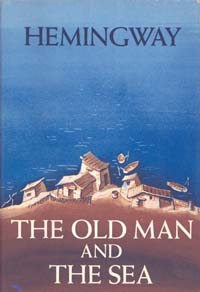 Original book cover | |
| Author | Ernest Hemingway |
|---|---|
| State | U.s. |
| Language | English |
| Genre | Literary Fiction |
| Published | 1952 (Charles Scribner'south Sons) |
| Media type | Impress (hardback & paperback) |
| Pages | 127 |
| Awards | Pulitzer Prize for Fiction (1953) Nobel Prize in Literature (1954) |
| ISBN | 0-684-80122-i |
| Dewey Decimal | 813.52 |
| LC Class | PS3515.E37 |
The Old Man and the Ocean is a novella written by the American author Ernest Hemingway in 1951 in Cayo Blanco (Cuba), and published in 1952.[1] Information technology was the final major work of fiction written by Hemingway that was published during his lifetime. One of his near famous works, it tells the story of Santiago, an aging Cuban fisherman who struggles with a behemothic marlin far out in the Gulf Stream off the coast of Republic of cuba.[two]
In 1953, The Old Human and the Sea was awarded the Pulitzer Prize for Fiction, and it was cited by the Nobel Committee as contributing to their awarding of the Nobel Prize in Literature to Hemingway in 1954.[2]
Plot summary [edit]
Santiago is an crumbling, experienced fisherman who has gone eighty-four days without catching a fish. He is now seen as "salao" (colloquial pronunciation of "salado", which means salty), the worst form of unlucky. Manolin, a swain whom Santiago has trained since childhood, has been forced by his parents to piece of work on a luckier gunkhole. Manolin remains dedicated to Santiago, visiting his shack each nighttime, hauling his line-fishing gear, preparing nutrient, and talking virtually American baseball and Santiago's favorite thespian, Joe DiMaggio. Santiago says that tomorrow, he volition venture far out into the Gulf Stream, due north of Cuba in the Straits of Florida to fish, confident that his unlucky streak is nigh its end.
On the lxxx-fifth day of his unlucky streak, Santiago takes his skiff out early. By noon, he has hooked a big fish that he is sure is a marlin, but he is unable to booty information technology in. He is unwilling to tie the line to the gunkhole for fear that a sudden jerk from the fish would break the line. With his back, shoulders, and hands, he holds the line for two days and nights. He gives slack as needed while the marlin pulls him far from land. He uses his other hooks to take hold of fish and a dolphinfish[a] to consume. The line cuts his hands, his torso is sore, and he sleeps little. Despite this, he expresses compassion and appreciation for the marlin, oftentimes referring to him as a brother. He determines that no one is worthy enough to eat the marlin.
On the tertiary solar day, the fatigued marlin begins to circle the skiff. Santiago, almost delirious, draws the line in, bringing the marlin towards the gunkhole. He pulls the marlin onto its side and stabs it with a harpoon, killing it. Seeing that the fish is too big to fit in the skiff, Santiago lashes it to the side of his boat. He sets sail for home, thinking of the high cost the fish volition bring him at the market and how many people he will feed.
The trail of claret from the dead marlin attracts sharks. Santiago berates himself for having gone out too far. He kills a great mako shark with his harpoon merely loses the weapon. He makes a spear by strapping his knife to the end of an oar. He kills iii more sharks before the blade of the knife snaps, and he clubs two more sharks into submission. But each shark has bitten the neat marlin, increasing the flow of blood. That night, an unabridged school of sharks arrives. Santiago attempts to beat out them back. When the oar breaks, Santiago rips out the skiff's tiller and continues fighting. Upon seeing a shark attempt to consume the marlin's caput, Santiago realizes the fish has been completely devoured. He tells the sharks they have killed his dreams.
Santiago reaches shore before dawn the next day. He struggles to his shack, leaving the fish head and skeleton with his skiff. Once home, he falls into a deep slumber. In the morn, Manolin finds Santiago. Every bit he leaves to get coffee for Santiago, he cries. A group of fishermen have gathered around the remains of the marlin. Ane of them measures it at 18 feet (v.5 m) from olfactory organ to tail. The fishermen tell Manolin to tell Santiago how sad they are. A pair of tourists at a nearby café mistake the dead fish for a shark. When Santiago wakes, he donates the head of the fish to Pedrico, a boyfriend fisherman who has long been kind to Santiago. He and Manolin promise to fish together once once more. Santiago returns to slumber, and he dreams of his youth and of lions on an African beach.
Background and publication [edit]
No good book has ever been written that has in it symbols arrived at beforehand and stuck in .... I tried to brand a existent erstwhile human, a real boy, a existent sea and a real fish and real sharks. But if I made them good and true enough they would hateful many things.
Ernest Hemingway in 1954[three]
Written in 1951, The Old Human and the Sea is Hemingway's final full-length work published during his lifetime. The book, dedicated to Charlie Scribner and to Hemingway's literary editor Max Perkins,[iv] [5] was simultaneously published in book form – featuring a embrace illustration by his young muse, Adriana Ivancich, [6] and black and white illustrations by Charles Tunnicliffe and Raymond Sheppard[7] – and featured in Life mag on September 1, 1952. The first edition print run of the book was fifty,000 copies and five million copies of the mag were sold in ii days.[viii] [9]
The One-time Human and the Sea became a Book of the Month Social club choice, and made Hemingway a celebrity.[x] In May 1953, the novel received the Pulitzer Prize[seven] and was specifically cited when in 1954 he was awarded the Nobel Prize in Literature which he defended to the Cuban people.[11] [12] The success of The Old Man and the Ocean made Hemingway an international celebrity.[ten] The Sometime Man and the Bounding main is taught at schools around the globe and continues to earn foreign royalties.[thirteen]
Literary significance and criticism [edit]
The Old Homo and the Sea served to reinvigorate Hemingway's literary reputation and prompted a reexamination of his entire torso of work. The novel was initially received with much popularity; it restored many readers' conviction in Hemingway's adequacy as an author. Its publisher, Scribner's, on an early on dust jacket, chosen the novel a "new classic", and many critics favorably compared it with such works as William Faulkner's 1942 brusque story The Carry and Herman Melville'southward 1851 novel Moby-Dick.
Several critics note that Santiago hails from the Canary Islands, and that his Spanish origins have an influence in the novella.[14] [15] [16] "Santiago is a Spaniard living in Cuba," Jeffrey Herlihy comments, and his "Spanish self is an absent just always-nowadays cistron in the novel."[17] Subsequently immigrating to Cuba in his 20s, he has adopted Cuban dress, nutrient preferences, and "speaks two dialects of the Spanish language."[18] Every night Santiago dreams about Spain, and this "nostalgic reminiscing—which is for the Canary Islands, not Republic of cuba—evidences the resonant influences of his Castilian/Canarian identity, foregrounding the migrant experience of the old man as a curtained foundation to the novella"[fourteen] His biography has many similarities to that of Gregorio Fuentes, Hemingway's commencement mate.[14]

Ernest Hemingway and Henry ("Mike") Strater with the remaining 500 lbs of an estimated 1000 lb marlin that was half-eaten by sharks before it could be landed in the Bahamas in 1935. See Pilar for details of this episode.
Gregorio Fuentes, who many critics believe was an inspiration for Santiago, was a blue-eyed human born on Lanzarote in the Canary Islands. Afterward going to sea at age ten on ships that called in African ports, he migrated permanently to Cuba when he was 22. After 82 years in Cuba, Fuentes attempted to reclaim his Spanish citizenship in 2001.[19] Critics take noted that Santiago was also at least 22 when he immigrated from Spain to Cuba, and thus quondam enough to be considered an immigrant—and a foreigner—in Cuba.[fourteen] [20]
Hemingway at showtime planned to use Santiago'due south story, which became The Onetime Man and the Sea, as part of an intimacy between mother and son. Relationships in the book relate to the Bible, which he referred to as "The Sea Book". Some aspects of information technology did announced in the posthumously published Islands in the Stream (1970). Hemingway mentions the real life feel of an old fisherman most identical to that of Santiago and his marlin in On the Blue H2o: A Gulf Stream Alphabetic character (Esquire, April 1936).[21] [22]
Joseph Waldmeir's 1957 essay "Confiteor Hominem: Ernest Hemingway's Religion of Human" is a favorable critical reading of the novel—and one which has divers analytical considerations since. Maybe the almost memorable claim is Waldmeir's reply to the question—What is the book'southward bulletin?
The answer assumes a tertiary level on which The Erstwhile Homo and the Sea must be read—as a sort of allegorical commentary on all his previous piece of work, past means of which it may exist established that the religious overtones of The Old Human being and the Ocean are not peculiar to that volume among Hemingway'south works, and that Hemingway has finally taken the decisive step in elevating what might be called his philosophy of Manhood to the level of a organized religion.[23]
Waldmeir considered the function of the novel'southward Christian imagery,[ original research? ] most notably through Hemingway'southward reference to the crucifixion of Christ post-obit Santiago'south sighting of the sharks that reads:
"Ay," he said aloud. There is no translation for this give-and-take and perchance it is just a racket such as a man might make, involuntarily, feeling the blast go through his easily and into the wood.[24]
One of the nigh outspoken critics of The One-time Human being and the Ocean is Robert P. Weeks. His 1962 piece "Fakery in The Onetime Human being and the Body of water" presents his statement that the novel is a weak and unexpected departure from the typical, realistic Hemingway (referring to the rest of Hemingway's body of work as "earlier glories").[25] In juxtaposing this novel against Hemingway'south previous works, Weeks contends:
The difference, notwithstanding, in the effectiveness with which Hemingway employs this characteristic device in his best work and in The Quondam Man and the Sea is illuminating. The work of fiction in which Hemingway devoted the about attending to natural objects, The Sometime Man and the Bounding main, is pieced out with an boggling quantity of fakery, extraordinary considering ane would expect to find no inexactness, no romanticizing of natural objects in a writer who loathed W. H. Hudson, could not read Thoreau, deplored Melville'south rhetoric in Moby Dick, and who was himself criticized by other writers, notably Faulkner, for his devotion to the facts and his unwillingness to 'invent.'[25]
Legacy [edit]
In 1954, Hemingway wanted to donate his Nobel Prize in Literature gold medal to the Cuban people. To avert giving information technology to the Batista government, he donated it to the Catholic Church for brandish at the sanctuary at El Cobre, a minor town exterior Santiago de Cuba where the Marian image of Our Lady of Charity is located. The Swedish medal was stolen in the mid-1980s, but the police force recovered it within a few days.[26] [27]
The Old Man and the Sea has been adapted for the screen 3 times: a 1958 film starring Spencer Tracy, a 1990 miniseries starring Anthony Quinn, and a 1999 animated short film. Information technology also inspired the 2012 Kazakhstani movie The Old Man, which replaces the fisherman with a shepherd struggling to protect his flock from wolves. Information technology is often taught in loftier schools equally a part of the U.Due south. literature curriculum. The book was reportedly a favorite of Saddam Hussein.[28]
In 2003, the book was listed at number 173 on the BBC's The Big Read poll of the Britain's 200 "all-time-loved novels".[29]
Notes [edit]
- ^ The fish is referred to as a "dolphin," a mutual proper name for dolphinfish. Santiago identifies it as a dolphinfish when he calls it dorado (p. 73), non delfín.
References [edit]
- ^ "From Ernest Hemingway to the Editors of Life". Life. Vol. 33, no. 8. August 25, 1952. p. 124. ISSN 0024-3019.
Hemingway's work is a 27,000-word novel chosen The Quondam Man and the Sea.
- ^ a b "The Nobel Prize in Literature 1954". The Nobel Foundation . Retrieved March 23, 2020.
- ^ "Books: An American Storyteller". Time. Dec 13, 1954. Retrieved February one, 2011.
- ^ Hemingway. The Old Man and the Sea. p. 5
- ^ Perkins, Maxwell (2004). Bruccoli, Matthew J.; Baughman, Judith (eds.). The sons of Maxwell Perkins: letters of F. Scott Fitzgerald, Ernest Hemingway, Thomas Wolfe, and their editor. University of South Carolina Printing. p. xxvii. ISBN1-57003-548-2.
- ^ Knigge 2012, p. 66.
- ^ a b Meyers 1985, p. 489
- ^ Oliver 1999, p. 247
- ^ "A Hemingway timeline Any human being'south life, told truly, is a novel". The Kansas City Star. KansasCity.com. June 27, 1999. Archived from the original on October 12, 2008. Retrieved August 29, 2009.
- ^ a b Desnoyers, p. thirteen
- ^ "Heroes:Life with Papa". Time. November 8, 1954. Retrieved December 12, 2009.
- ^ "The Nobel Prize in Literature 1954". Nobelprize.org. Retrieved October 4, 2009.
- ^ Meyers 1985, p. 485
- ^ a b c d Herlihy-Mera, Jeffrey (2017). "Cuba in Hemingway". The Hemingway Review. 36 (two): 8–41. doi:10.1353/hem.2017.0001. S2CID 149158145.
- ^ Guinea Ulecia, Mercedes (2016). "Hibridación lingüística y cultural en autores norteamericanos de origen español". Universidad de Huelva. diss.: 105–107.
- ^ Herlihy, Jeffrey (2009). "Santiago's Expatriation from Spain". The Hemingway Review. 28: 25–44.
- ^ Herlihy, Jeffrey (2011). In Paris or Paname: Hemingway's Expatriate Nationalism. New York: Rodopi. p. 102. ISBN978-9042034099.
- ^ Herlihy, Jeffrey (2011). In Paris or Paname: Hemingway'due south Expatriate Nationalism. New York: Rodopi. p. 117. ISBN978-9042034099.
- ^ "El pescador que inspiró a Hemingway 'El viejo y el mar' recupera la nacionalidad española". Retrieved June 7, 2013.
- ^ Herlihy, Jeffrey. "Eyes the same colour as the sea: Santiago's Expatriation from Spain and Ethnic Otherness and in Hemingway's the Old Human being and the Sea". Hemingway Review. Retrieved Apr 17, 2015.
- ^ Onetime Man and the Bounding main. Introduction: The Ripening of a Masterpiece. Simon and Schuster. Retrieved September 29, 2012.
- ^ Hemingway, Ernest (edited by William White) (1967). By-Line: Ernest Hemingway. Selected manufactures and dispatches of four decades. New York: Scribner's.
- ^ Joseph Waldmeir (1957). "Confiteor Hominem: Ernest Hemingway's Organized religion of Man". Papers of the Michigan Academy of Sciences, Arts, and Letters. XLII: 349–356.
- ^ Hemingway. The One-time Man and the Body of water. p. 118
- ^ a b Robert P. Weeks, Robert P. (1962). "Fakery in The Old Man and the Body of water". College English. XXIV (iii): 188–192. doi:10.2307/373283. JSTOR 373283.
- ^ Miller, Tom (Oct 4, 2009). "Off The Shelf: The solar day Hemingway'south Nobel Prize came out of hiding". Los Angeles Times . Retrieved June vi, 2020.
- ^ "Huffington Post". HuffPost. March 27, 2012. Retrieved October vii, 2014.
- ^ "Government Strategic Intent — Central Intelligence Bureau". www.cia.gov. Archived from the original on June 13, 2007.
- ^ "BBC – The Big Read". BBC. April 2003, Retrieved Baronial 23, 2017
Further reading [edit]
- Baker, Carlos (1972). Hemingway: The Writer every bit Artist (4th ed.). Princeton University Press. ISBN0-691-01305-5.
- Jobes, Katharine T., ed. (1968). Twentieth Century Interpretations of The Old Man and the Sea. Englewood Cliffs, New Jersey: Prentice Hall. ISBN0-xiii-633917-four.
- Knigge, Jobst C. (2012). "Hemingway's Venetian muse Adriana Ivancich" (PDF). A Contribution to the Biography of Ernest Hemingway.
- Mellow, James R. (1992). Hemingway: A Life Without Consequences. New York: Houghton Mifflin. ISBN0-395-37777-3.
- Young, Philip (1952). Ernest Hemingway . New York: Holt, Rinehart, & Winston. ISBN0-8166-0191-7.
- Rosella Mamoli Zorzi; Gianni Moriani; Arrigo Cipriani (2011). In Venice and in the Veneto with Ernest Hemingway. In Venice and in the Veneto with... (in English and Italian). Venice: Supernova. pp. 3, 62. ISBN9788896220474. OCLC 843177468. Archived from the original on September 8, 2019.
External links [edit]
- The Old Man and the Ocean at Faded Folio (Canada)
- Rare, Unseen: Hemingway in Cuba—slideshow by Life mag
- "Michael Palin's Hemingway Take a chance: Republic of cuba". PBS. Retrieved January 21, 2006.
Source: https://en.wikipedia.org/wiki/The_Old_Man_and_the_Sea
0 Response to "By the End of Novella Why Does Mandlin Decide That He Will Once Again Fish Wiht Santiago"
Post a Comment